Organising Erasm us Intensive Language Courses has become a tradition at the University of Nova Gorica. Thus, for the second time, courses of Slovene were organised for foreign Erasmus students who had decided to spend their Erasmus study period at one of the Slovene universities.
The courses were funded through the Lifelong Learning Programme of the European Commission* and took place between 6th and 24th September 2010 .
The university hosted 28 students from 12 different countries – the Czech Republic, Poland, Turkey, Finland, Germany, Hungary, France, Portugal, Spain, Lithuania, Romania and Slovakia.

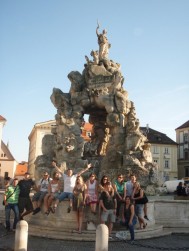
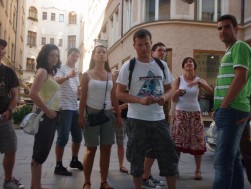
EILC students in front of the main University's building
The courses were carried out on the beginner’s (A1) level, developing all four types of the students’ skills – speaking, listening, reading and writing. The objective of the course was to teach foreign students basic expressions, vocabulary as well as basic grammatical structures of the Slovene language in order to develop the students’ linguistic ability to function in everyday conversational situations in the local environment.
On the first day, the university organised the so-called “Welcome Day”, where the students got all the necessary information about the course programme, extra activities organised, the university and the Nova Gorica region. The students also got the so-called “info packs” containing brochures, maps and other useful materials.

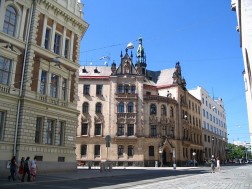
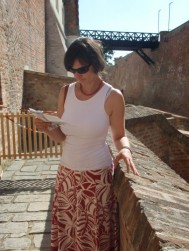
Sightseeing in Ajdovščina
In the mornings, the students were busy with lectures. They had 60 hours of lessons altogether, 4 per day. Besides teaching the students Slovene, the University has a policy to offer the EILC participants the possibility to experience Slovenia in every possible way; from learning about the Slovene culture, history and traditions to encouraging the students to learn about the EILC participant countries by socializing with each other and organising common trips, sports events, parties, etc.
Some of the main extra activities, organised by the University were:
– the trip to the Postojna cave and the Predjama castle
We visited the mysterious Karst region, famous for its underground caves, with the Postojna cave perhaps being the most attractive cave in the world. Visiting the adjacent Predjama castle is a must – an imposing medieval castle, built in the rock face, partly in a cave is an unforgattable experience. And the students also loved to hear the legend about the castle’s most famous inhabitant, the knight named Erasmus (what a coincidence;)). Dinner at a medieval restaurant in Postojna followed.
– the Soča river rafting trip

No comment needed. Fun, fun, fun …
– the trip to Trieste, Sistiana/Duino and Redipuglia
We visited the nearby Italian city of Trieste. The lovely mediterranean town with rich history and attractive architecture charmed us. After exploring the old town and tasting prosciutto and delicious Italian ice cream, we headed to the Miramar castle – a truly wonderful building in a splendid location, with its castle gardens extending towards the rocky coastline. The next stop was Sistiana, a summer beach resort, which offeres more than the sea and sunshine – there’s the coastal “Rilke’s path” which we walked and had the opportunity to enjoy magnificent views of the coastal cliffs, the sea, the lovely Medditerranean flora and the view of the Duino castle, sitting on a clifftop. No wonder why Rilke, the famous Bohemian-Austrian poet (1875 –1926), got the inspiration for his Duino elegies there. The last stop was the Redipuglia military monument, a resting place of the 100,000 soldiers, victims of the First World War. Despite the place’s grim history, this architectural masterpiece and its rich history definitely make this sight worth visiting;


– the traditional “wine tour” – grape picking in the university’s vineyard and wine tasting at the School of Viticulture and Enology of the University of Nova Gorica
We live in a wine-growing region and therefore we offered the students a unique opportunity to learn about wine-making and wine itself. The School of Viticulture and Enology of the University of Nova Gorica hosted the EILC students – first in the university’s vineyard, where the students learned all about grapevines and grape-picking and took part in the traditional process of harvesting. The students enjoyed picking (and also eating, of course) grapes and learning how the grapes are turned into wine. The School of Viticulture and Enology prepared lunch for the hungy grape-pickers at the school’s headquarters in Ajdovščina. After lunch, the lectures of Slovene followed. Then we made a short tour around Ajdovščina, had a delicious ice cream of local production and visited the Roman remains in the old part of the town. Back at the School of Viticulture and Enology, we had a great wine-tasting session, where we learnt all about different types of wine, making wine and serving wine as well. The students’ “sommelier” knowledge about was impressive a the end of the session – they were able to describe each wine sample, define the type of wine and even serve it in the right way! The wine experience continued by driving to Goče, a charming little village, and visiting a small local winery, Cejkotova domačija. Our dinner – old regional traditional dishes were served in a great setting – an old, restored house with a homely atmosphere and a lovely terrace, from where we could admire the view of the hills, covered in vineyards, and the old, still preserved part of the village. Finally, the owner of the winery took us to his centuries-old wine cellar and in the candle light we could relax and listen to his stories and local legends about wine.


– other cultural events (traditional Slovene lunch at the university, watching a Slovene film, visiting the Borela traditional festival in Vrtojba, etc.)
Moreover, this year the University introduced a novelty: in order to help the students learn more about their future professional fields, we organised visits to various institutions, where the students met some experts of their field of study and were able to learn how things are organised in Slovenia.
Thus, the following visits were organised:
– a visit to the local kindergartens in Ajdovščina and Vipava, where
two Finnish students of pre-school education had the opportunity to learn about the system of pre-school education in Slovenia, observe practical activities with children and compare the traditional kindergarten programme to that of the newly-introduced Montessori programme;
– a visit to the laboratories of the School of Environmental Sciences of the University of Nova Gorica, where the students of related sciences got an insight into the research activities performed there, as well as learn about the machines and equipment used (yes, including learning Slovene names of machines, materials, etc.!). The experiment of creating self-cleaning surfaces by the introduction of TiO2 layers was also presented.

Forming new friendsips
The University also offered the students assistance with organising private trips and we are glad that the students took advantage of the opportunities to visit different places or oganise different events – trips to Bled, the Slovene coast, the Soča valley, Venice, a day on the beach in the resort of Grado, a shopping trip to Palmanova, volleyball and football tournaments, parties at the local clubs etc.
We are glad to confirm that all the EILC students have successfully completed the course of Slovene and received an official certificate with the assigned ECTS. We sincerely hope the knowledge gained will help them in the future.
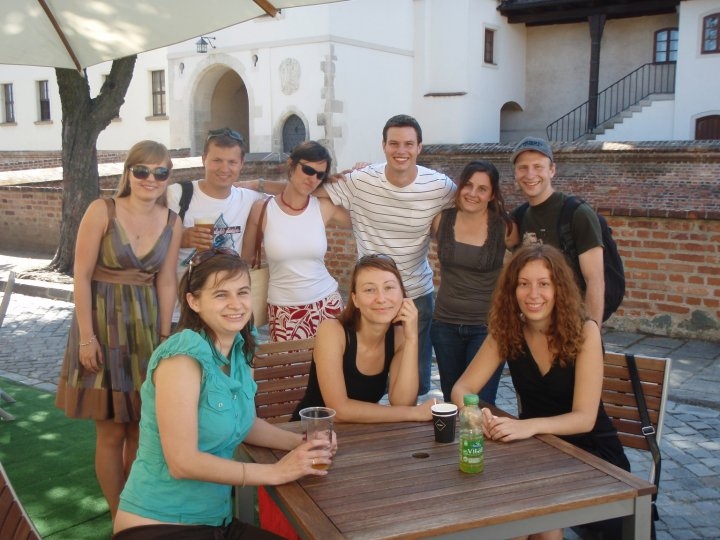
Moreover, we are happy to hear that the students are still in touch with each other and that long-lasting friendships have been formed. We are looking forward to hearing about the students’ reunions and hoping that you are enjoying your Erasmus period in Slovenia.

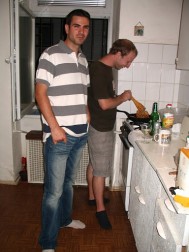
EILC members ... in a different way
If you are a foreign student planning to spend your Erasmus period in Slovenia, we warmly recommend you to attend a free EILC course of Slovene at the University of Nova Gorica.
Click for more info
*Disclaimer: The sole responsibility for the content of this publication lies with the authors. The European Commission is not responsible for any use of the information contained therein.
 Študijsko in kulturno življenje v velemestni Pragi ponuja številne možnosti, ki jih kar najbolje izkoriščava. Vpisali sva se na različne seminarje, redno hodiva v kino, gledališče, na literarne večere, razstave, koncerte itd. Odvilo se je že kar nekaj zanimivih simpozijev s področja najinega študija.